Also: the third man on the Moon used his first words to win a bet.
PROFESSIONAL
DEVELOPMENT |
STAFF NO. UNASSIGNED
DIRECT REPORTS 0
THU 15:04
|
|
|
Issue 15 · Thursday afternoon
|
Thursday afternoon. The all-hands ran 40 minutes over and the last slide just said “Questions?” | Pete Conrad’s first words on the Moon were to win a bet. - Fifty-seven years ago today, Pete Conrad became the third person to walk on the Moon, and he picked his first words to win a bet.
- Before Apollo 12 the Italian journalist Oriana Fallaci had told him she was sure NASA had scripted Neil Armstrong’s line.
- Conrad was 5 foot 6. He bet her $500 that astronauts could say whatever they liked, and told her exactly what he’d say.
- On 19 November 1969 he stepped off the ladder and said, “Whoopie! Man, that may have been a small one for Neil, but that’s a long one for me.”
- He said for years afterwards that she never paid up.
Space.com → | Windows Solitaire was written by an intern, for nothing. - Wes Cherry wrote it in his own time as a summer intern at Microsoft in 1988, and a program manager picked it up for Windows 3.0 in 1990.
- The usual story is that it was there to teach people who’d only ever used keyboards how to drag and drop with a mouse.
- Cherry had built in a boss key that hid the game when someone walked past, and Microsoft made him take it out.
- He never got royalties. Asked if that made him bitter, he said, “Yeah, especially since you are all probably paid to play it!”
I Programmer → | The Pony Express lasted 18 months. - It started on 3 April 1860, with riders carrying mail about 1,900 miles between St Joseph, Missouri, and Sacramento in about ten days.
- The riders swore an oath against swearing, drinking and fighting, and the business lost money the whole time it ran.
- On 24 October 1861 the transcontinental telegraph was finished, and something that had taken the riders ten days now took minutes.
- The Pony Express shut two days later, so the old system and the new one ran side by side for a grand total of 48 hours.
Smithsonian National Postal Museum → |  | The longer one | A few appropriate remarks | In September 1863 a Gettysburg lawyer called David Wills was organising the dedication of a cemetery for the Union dead from that July’s battle. He wanted the best speaker in the country, and that was Edward Everett: former president of Harvard, former Secretary of State, former senator, and a man people paid to hear. | The ceremony was set for 23 October. Everett replied that he couldn’t possibly be ready by then, so the date was moved to suit him, to Thursday 19 November. | The President was invited on 2 November, about two weeks out. Wills asked him for “a few appropriate remarks” once the main speaker had finished. | Everett did the work. He researched the battle and spoke to people who had fought in it. On the day he spoke from memory for two hours, about 13,600 words covering all three days of fighting, and by most accounts it was very good. | After a hymn, Lincoln stood up and spoke for about two minutes, around 270 words. He told the crowd the world “will little note, nor long remember what we say here”, and sat down. | The next day Everett wrote to him that he’d be glad if he could flatter himself that he “came as near to the central idea of the occasion, in two hours, as you did in two minutes.” Lincoln replied the same day: “you could not have been excused to make a short address, nor I a long one.” | Lincoln kept the letter. Of everything Everett said that day, his thank-you note is the only line anyone still quotes. | Two hours on the agenda, and the bit everyone remembers is his follow-up email. | National Park Service → | Course materials | 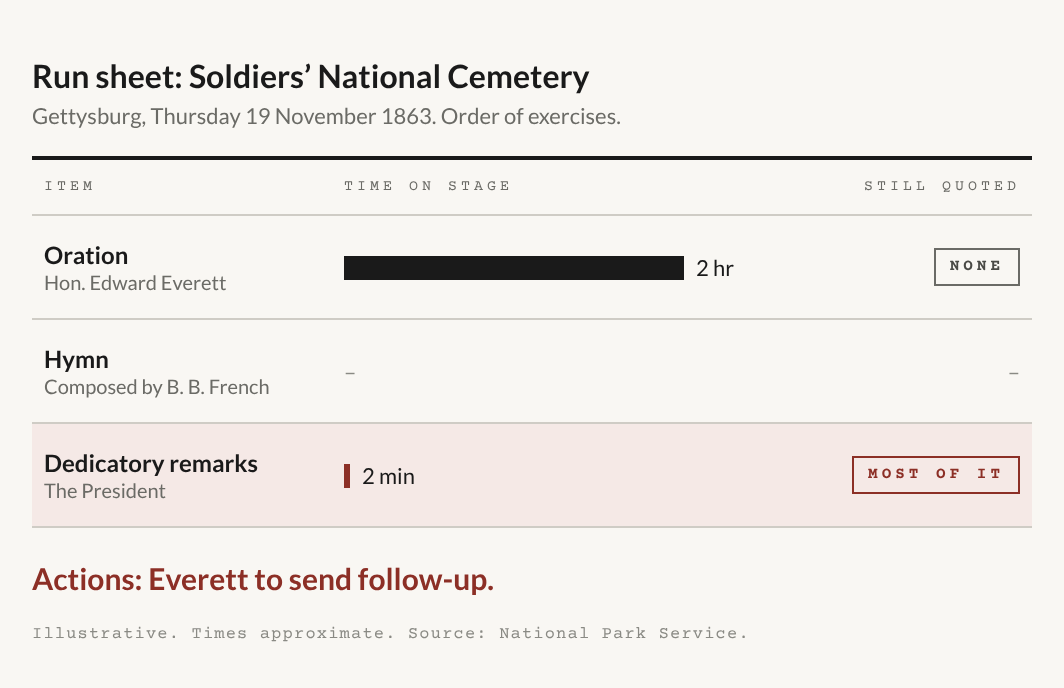 |
|
Staff record
STAFF NO. UNASSIGNED
You’re reading someone else’s copy. Subscribers get a staff number. It’s a rank, not an ID, and everyone who joins after you sits below you, permanently.
|
|
That’s it. Go home. |
|
Professional Development · sent Thursdays, when it stops mattering
Issue 15 | SUBSCRIBE → |
|
|