PROFESSIONAL
DEVELOPMENT |
STAFF NO. UNASSIGNED
DIRECT REPORTS 0
THU 15:04
|
|
|
Issue 14 · Thursday afternoon
|
Thursday afternoon. The Secret Santa spreadsheet has gone out and it has a tab for exclusions. | Fifty-six years ago today, Oregon blew up a whale. - On 12 November 1970 an eight-ton sperm whale washed up on the beach at Florence, Oregon, and getting rid of it became a job for the state highway division.
- The engineer in charge, George Thornton, decided to deal with it like a boulder and packed it with half a ton of dynamite.
- A man from Springfield called Walt Umenhofer, who’d had explosives training in the war, told him that was far too much, and was ignored.
- When it went off, blubber rained down on the crowd, and one chunk flattened Umenhofer’s new Oldsmobile, which he’d bought days earlier in a “Whale of a Deal” promotion.
Offbeat Oregon → | Movember started in a Melbourne pub, without a cause. - In 2003 two mates, Travis Garone and Luke Slattery, decided over a beer in Melbourne that the moustache was due a comeback.
- They talked 30 friends into growing one for November, mostly to see what would happen.
- It went well enough that the next year they tied it to a cause, and 450 men raised $54,000 for the Prostate Cancer Foundation of Australia.
- Movember says nearly seven million people have taken part since, which is a lot of men who’ve had to explain the moustache in a client meeting.
Movember → | Norway’s giant paper clip is the wrong paper clip. - Norwegians grew up being told the paper clip was invented by one of their own, Johan Vaaler, who patented a wire clip in 1899.
- His design didn’t really work, because it was missing the second loop that gives a clip its grip.
- The one everyone actually uses, the Gem, was probably being made in Britain years earlier and was never patented at all.
- The myth stuck anyway, helped by Norwegians wearing clips on their lapels as a quiet sign of resistance in the war, and in 1989 a seven-metre statue of Vaaler’s invention went up near Oslo, in the shape of the Gem.
Great Patent → |  | The longer one | One cent a tail | In 1902 Hanoi was the capital of French Indochina, and the French were proud of it. They’d laid out wide boulevards and a European quarter, and underneath it more than nine miles of modern sewers. | The rats liked the sewers even more. They were cool, dark and free of predators, and they ran straight into the nicest houses in town. With plague in the region, that was a problem. | So the city paid Vietnamese rat catchers to go down into the pipes and bring rats out, per rat. It worked. In the last week of April they brought up 7,985. By June it was more than 10,000 a day, peaking at 20,112 on 21 June. | It worked so well that the dead rats piling up at city hall became a problem of their own. So the rules changed: bring in just the tail, and get one cent for each. | That’s when people started seeing rats around Hanoi with no tails. Someone had worked out that a rat without a tail is still a rat. It keeps breeding, and its children have tails. Then health inspectors found farms on the edge of the city raising rats for the bounty, and a trade in rats brought in from the countryside. | The French scrapped the bounty. The rats stayed. In 1906 plague broke out anyway and killed at least 263 people. | The historian Michael Vann found all of this in the 1990s, in a French archive file labelled “Destruction of Animals: Rats”. Economists know the idea as Goodhart’s law: once a measure becomes a target, it stops being a good measure. Hanoi got there 73 years before Goodhart, with a ledger of tails. | They asked for tails, so they got tails. | Atlas Obscura → | Course materials | 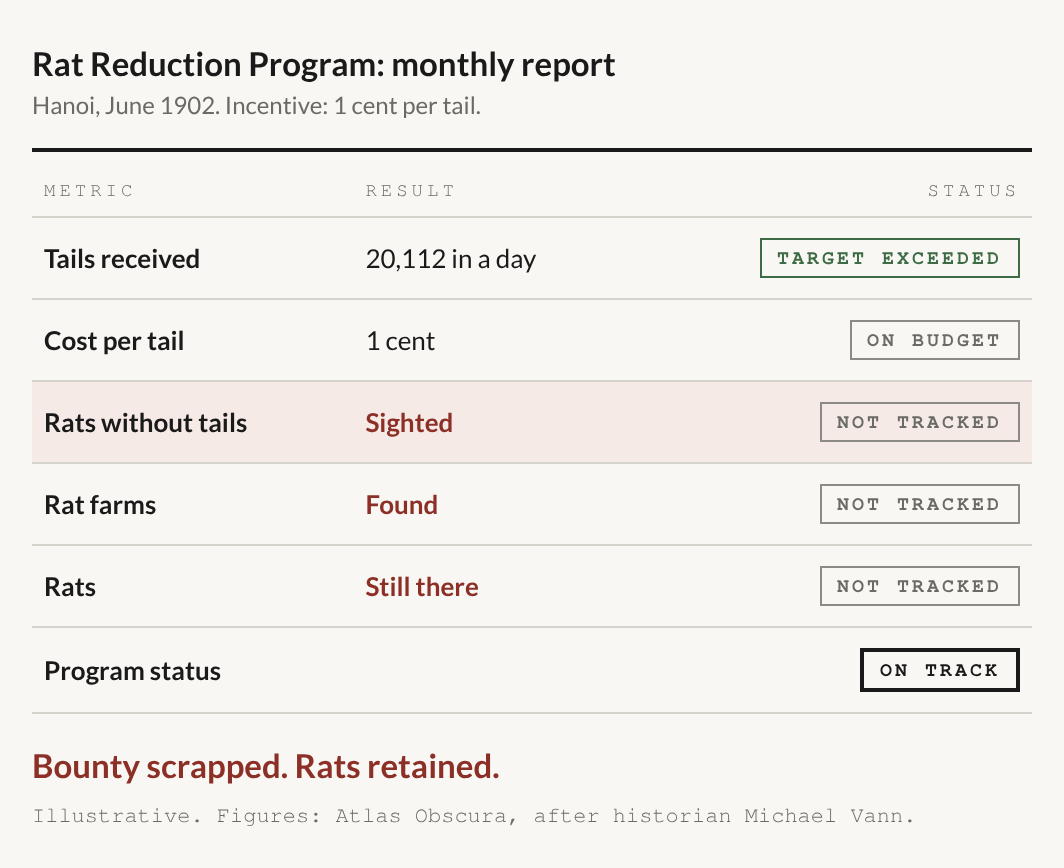 |
|
Staff record
STAFF NO. UNASSIGNED
You’re reading someone else’s copy. Subscribers get a staff number. It’s a rank, not an ID, and everyone who joins after you sits below you, permanently.
|
|
That’s it. Go home. |
|
Professional Development · sent Thursdays, when it stops mattering
Issue 14 | SUBSCRIBE → |
|
|