PROFESSIONAL
DEVELOPMENT |
STAFF NO. UNASSIGNED
DIRECT REPORTS 0
THU 15:04
|
|
|
Issue 11 · Thursday afternoon
|
Thursday afternoon. Printed one page this morning and it came out on a different floor. | The first photocopy was made 88 years ago today, in a rented room in Queens. - Chester Carlson ran the patent department at an electronics firm in New York, and a lot of the job was copying documents out by hand, which his arthritis made painful.
- On 22 October 1938, in a room he rented from his mother-in-law in Astoria, his assistant Otto Kornei wrote “10-22-38 ASTORIA” on a glass slide in ink.
- They charged a sulphur-coated zinc plate by rubbing it with a handkerchief, shone a light through the slide onto it, dusted it with powder and pressed the image onto wax paper.
- More than 20 companies turned it down over the next few years, including IBM, GE, Kodak and RCA, and the first proper office copier, the Xerox 914, didn’t arrive until 1959.
APS News → | The fax machine is older than the telephone. - In 1843 Alexander Bain, a clockmaker from Caithness at the top of Scotland, patented a way to send an image down a telegraph wire.
- The trick was two pendulums, one at each end, kept swinging in time, so one could scan the message line by line while the other printed it out.
- By 1865 France was running a commercial fax service between Paris and Lyon, on a machine built by an Italian priest called Giovanni Caselli.
- Bell didn’t patent the telephone until 1876, so for more than 30 years you could fax someone but couldn’t ring to check they’d got it.
Undiscovered Scotland → | Leonardo da Vinci’s job application barely mentions painting. - Around 1482, when he was about 30, Leonardo wrote to Ludovico Sforza, the ruler of Milan, asking for work.
- Most of the letter is a list of military engineering he could do, from light portable bridges and siege machines to cannons, armoured vehicles and secret tunnels.
- For peacetime he offered buildings and moving water from one place to another, and right at the end he adds that he can sculpt, “and also painting”.
- He got the job and spent years on a giant bronze horse he’d also offered, until the bronze went to make cannons and French soldiers used his clay model for target practice.
Smarthistory → |  | The longer one | A cosmic laboratory of baby training | If you’ve worked anywhere with an HR team, someone has probably told you you’re an INTJ. The test that told them was put together at home by a mother and her daughter, and neither of them had any training in psychology. | Katharine Briggs went to college at 14 and finished top of her class, then married and was expected to keep house. She treated that as research. She handed neighbourhood parents questionnaires about their children, and called her living room a “cosmic laboratory of baby training”. | In the 1920s she read Carl Jung’s Psychological Types and wrote to him. She came to believe people sorted into types, but that you could only type someone after knowing them for a long time, not from a form. | Her daughter Isabel was busy writing detective novels. The first, Murder Yet to Come, won a $7,500 magazine prize, beating, by most accounts, a young Ellery Queen. Then the Second World War sent millions of new workers into factories and offices, and Isabel decided what employers needed was a questionnaire that matched people to jobs. | She learnt how to build tests from a personnel consultant, Edward Hay, and had a first version by 1943. One of its first buyers ran a station for the OSS, America’s wartime spy agency, and used it to match agents to missions. Her mother thought the yes-or-no questions missed the point. Type, she said, is never so simple. | Psychologists weren’t convinced either. In 1960 the Educational Testing Service gave a young researcher the job of writing its manual, and he wrote a critique instead: most people land near the middle of each scale, not clearly on one side. It spread anyway, and took off in big companies in the 1980s, after Isabel had died. Most of the Fortune 100 now use it. | Take it again five weeks later and there’s about a one in two chance you come out a different type. | Sixteen boxes, and half of us will have moved by the next offsite. | WNYC Science Diction → | Course materials | 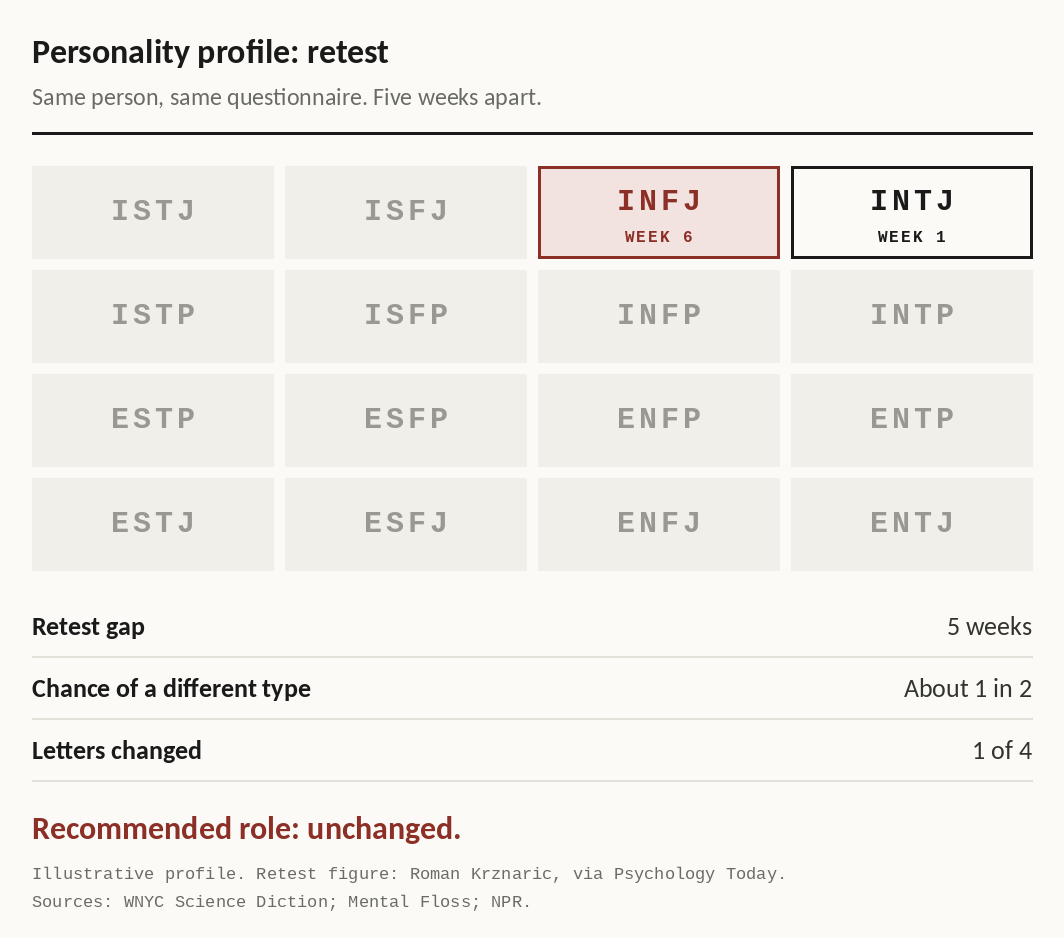 |
|
Staff record
STAFF NO. UNASSIGNED
You’re reading someone else’s copy. Subscribers get a staff number. It’s a rank, not an ID, and everyone who joins after you sits below you, permanently.
|
|
That’s it. Go home. |
|
Professional Development · sent Thursdays, when it stops mattering
Issue 11 | SUBSCRIBE → |
|
|