Also: Microsoft’s email was taken down by people asking to be taken off a list.
PROFESSIONAL
DEVELOPMENT |
STAFF NO. UNASSIGNED
THU 15:04
|
|
|
Issue 10 · Thursday afternoon
|
Thursday afternoon. Spent the morning in a meeting about next week’s meeting. | Microsoft’s email was knocked out by people asking to be taken off a list. - On 14 October 1997, someone at Microsoft noticed they were on a distribution list called Bedlam DL3 and emailed all 13,000 members asking to be removed.
- Others hit reply all to ask to be removed too, and then a third group hit reply all to ask everyone to stop hitting reply all.
- Within about an hour there were more than 15 million emails, and the mail servers stopped, including for people who weren’t on the list.
- It took two days to clean up, and someone printed T-shirts reading “I survived Bedlam3” on the front and “Me too!” on the back.
Rodney Bliss, who was there → | The first deadline was a line you could be shot for crossing. - At the Confederate prison at Andersonville, Georgia, guards marked a line about 20 feet inside the stockade wall, and any prisoner who crossed it could be shot.
- Northern newspapers were calling it the “dead line” by 1864.
- Around the turn of the century printers took the word for the edge of the page the press couldn’t print past.
- By 1904 newspapers were using it for the time copy had to be in, and since then crossing one has had no consequences at all, which is why it gets pushed four times.
Saturday Evening Post → | An Australian council once gave NASA a $400 ticket for littering. - Skylab, America’s first space station, came down just after midnight on 12 July 1979, and a lot of it landed around Esperance in WA.
- A 17-year-old called Stan Thornton picked pieces off his roof and flew to San Francisco to claim the $10,000 a newspaper had offered for the first bit delivered.
- The Shire of Esperance went the other way, and its litter inspector handed a visiting NASA official a $400 fine.
- It was a joke and NASA never paid it, until 2009, when an American radio host raised the money from his listeners and sent it in.
Perth Observatory → |  | The longer one | A magnificent navy on land | In November 1955 The Economist ran an unsigned essay that opened with a line most people have heard: “work expands so as to fill the time available for its completion.” It was a joke. The author was Cyril Northcote Parkinson, a naval historian teaching at the University of Malaya in Singapore. | His first example was an elderly lady with nothing else to do, who could spend an entire day sending one postcard to her niece in Bognor Regis. There was the card to find, then her glasses, then the address, then a long think about whether to take an umbrella to the postbox. A busy man would do the same thing in about three minutes. | Then came the numbers. Between 1914 and 1928 the Royal Navy’s capital ships went from 62 to 20, and its officers and men from 146,000 to 100,000. Over the same years the number of Admiralty officials went from 2,000 to 3,569. Parkinson called it “a magnificent navy on land”. | He explained it with two rules. An official wants to multiply subordinates, not rivals. And officials make work for each other. An overworked manager won’t share the load with a peer who might one day replace him. He hires two juniors, and they produce enough paperwork to keep each other, and him, busy until late in the evening. | The Colonial Office did the same thing. Its staff grew from 372 in 1935 to 1,661 in 1954, while the empire it ran was shrinking. Parkinson worked out that an administrative department grows about 6% a year whether or not there is any more work to do. | In 1994 a naval historian went back and checked his figures. Parkinson’s 1914 Admiralty number was about a quarter too high. With the correct figure, the growth was even bigger. | Nobody hires a rival. Everybody hires two assistants. | Naval History magazine → | Course materials | 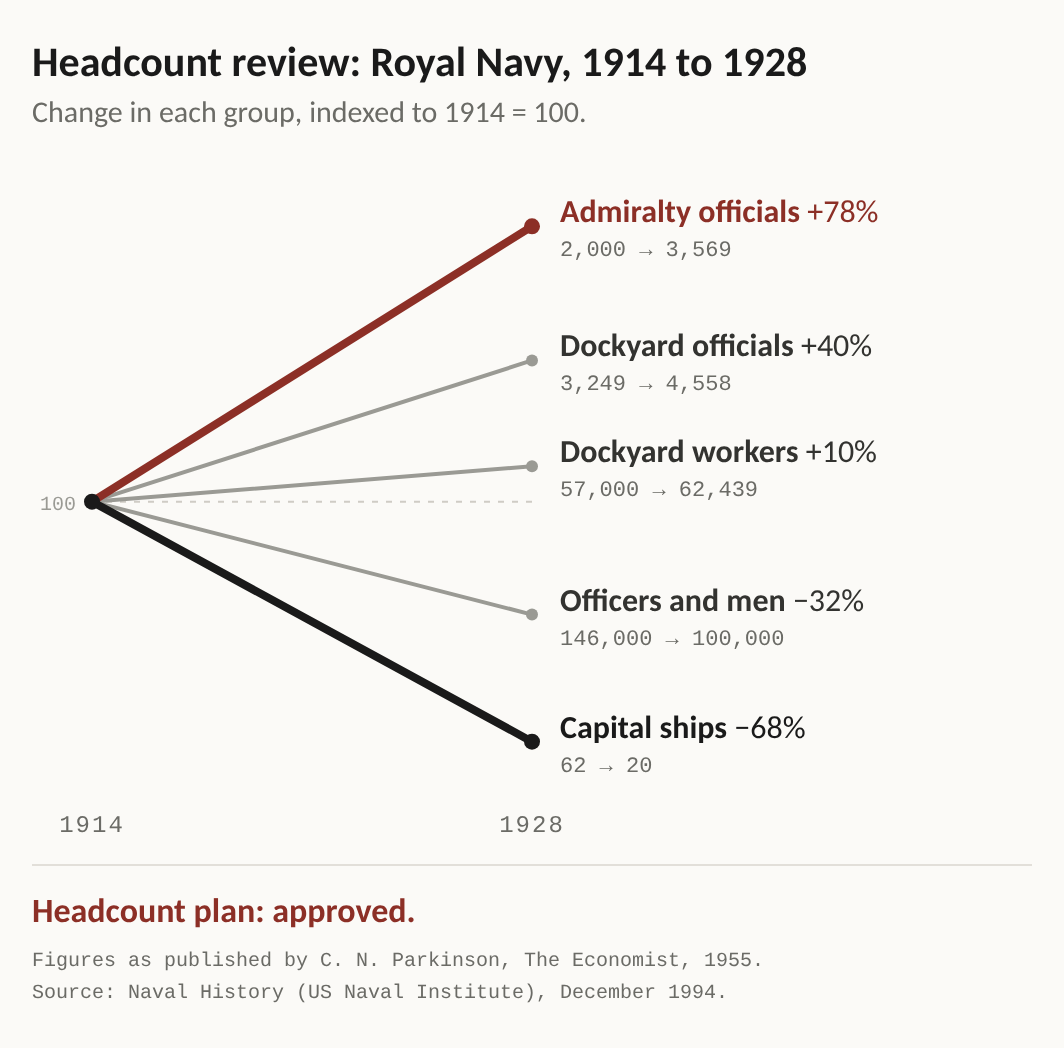 |
|
Staff record
STAFF NO. UNASSIGNED
You’re reading someone else’s copy. Subscribers get a staff number. It’s a rank, not an ID, and everyone who joins after you sits below you, permanently.
|
|
That’s it. Go home. |
|
Professional Development · sent Thursdays, when it stops mattering
Issue 10 | SUBSCRIBE → |
|
|