Also: one of the first things sold on eBay was a broken laser pointer.
PROFESSIONAL
DEVELOPMENT |
STAFF NO. UNASSIGNED
THU 15:04
|
|
|
Issue 07 · Thursday afternoon
|
Thursday afternoon. Every email I’ve sent since lunch has ended with “let’s pick this up next week”. | The kiwifruit was renamed because of the Cold War. - New Zealand growers had been selling it to America as the Chinese gooseberry, which in the late 1950s was not a name anyone wanted in their shopping trolley.
- Their first fix was “melonette”, but that ran into a different problem, because US import duties on melons and berries were steep.
- So the American importer asked for something short and unmistakably New Zealand, and in June 1959 Jack Turner of Turners and Growers suggested naming it after the national bird.
- By 1970 every export carried the name.
NZ History → | One of the first things ever sold on eBay was a broken laser pointer. - Pierre Omidyar launched the site, then called AuctionWeb, over a long weekend in 1995 as a side project.
- He listed a laser pointer that no longer worked, said so in the listing, and it still sold for $14.83.
- Slightly worried, he contacted the winning bidder to make sure he understood it was broken.
- The buyer explained that he was a collector of broken laser pointers.
TIME → | Ctrl+Alt+Del was built so that nobody would ever press it by accident. - In 1980 David Bradley, one of the engineers on the original IBM PC, needed a way for the team to restart their machines without switching the power off and waiting.
- He chose three keys you could never hit together by mistake, because it was only ever meant for the people building the thing.
- Then IBM put it in the technical manual, and everyone found out.
- At the PC’s 20th anniversary in 2001, sitting next to Bill Gates, he said: “I may have invented it, but I think Bill made it famous.”
Wikipedia → |  | The longer one | Music for the 3pm slump | Muzak started as a clever bit of plumbing. George Owen Squier, the US Army’s chief signal officer in the First World War, worked out how to send music down electrical wires, and in 1934 his company began piping it into buildings. He named it by mashing “music” into “Kodak”, a brand name he admired. | The idea that turned it into a business came from the factory floor. In the late 1940s, researchers testing music on workers reported that output went up when the loud brass and the vocals came out and the strings and woodwinds went in. The lesson Muzak took from this was that the music worked best when nobody was really listening to it. It was meant to be heard, not listened to. | From there it became a system, which the company called Stimulus Progression. Every song in the library was given a mood rating, from gloomy to ecstatic. Songs were played in 15-minute blocks of five or six, each a little more upbeat than the one before, followed by 15 minutes of silence so the music never turned into something you noticed. The blocks were then arranged around the working day. The music got livelier through the late-morning dip, eased off after lunch to “counteract the excitement”, and pushed hardest in the middle of the afternoon, when people slow down the most. | It sold extremely well. The White House was wired for it in 1953. Lyndon Johnson owned the Muzak franchise in Austin, Texas. It reportedly went to the moon on Apollo 11. Ted Nugent once offered $10 million for the company, purely so he could shut it down. | Whether any of it worked is harder to say, since most of the productivity research was Muzak’s own. The company eventually went bankrupt, was bought in 2011, and had its name retired by the new owners in 2013. The idea outlived it, though. The music in your supermarket, gym and office lobby is still scheduled by the hour. | It was designed to be heard, not listened to. Much like the all-hands. | HistoryLink → | Course materials | 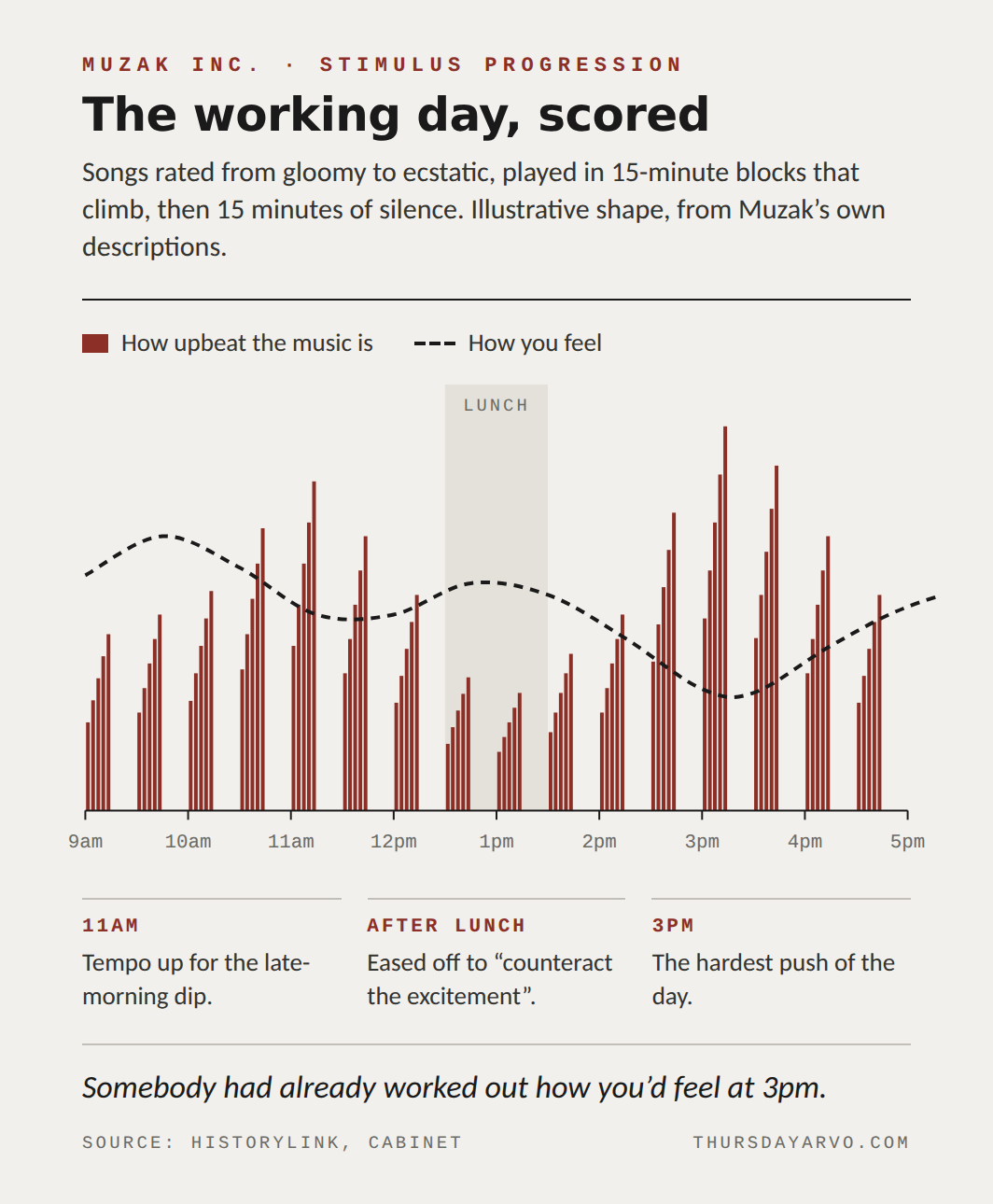 |
|
Staff record
STAFF NO. UNASSIGNED
You’re reading someone else’s copy. Subscribers get a staff number. It’s a rank, not an ID, and everyone who joins after you sits below you, permanently.
|
|
That’s it. Go home. |
|
Professional Development · sent Thursdays, when it stops mattering
Issue 07 | SUBSCRIBE → |
|
|