Also: the seven years Vegemite spent as Parwill.
PROFESSIONAL
DEVELOPMENT |
THU 15:04
|
|
|
Issue 05 · Thursday afternoon
|
|
Staff record
STAFF NO. UNASSIGNED
You’re reading someone else’s copy. Subscribers get a staff number. It’s a rank, not an ID, and everyone who joins after you sits below you, permanently.
|
|
Nothing below is actionable. That is the arrangement. | Three of them are short. One isn’t. | Vegemite spent seven years as Parwill. - Marmite had run the Australian market since 1910. Vegemite launched in 1923 and sat there.
- Fred Walker’s answer in 1928 was to rename his own product Parwill.
- The slogan was “Marmite but Parwill”. If Ma might, then Pa will.
- Vegemite’s own corporate timeline says Parwill was only ever sold in Queensland.
- It ran until 1935. Seven years of a joke nobody was laughing at.
- He changed the name back and the market share still didn’t return.
- What finally worked: free jars with Kraft cheese, then a limerick contest with Pontiacs.
Vegemite Heritage → | The rarest insect on earth spent 80 years under one bush. - The SS Makambo ran aground at Lord Howe Island in 1918. Black rats came ashore.
- Within a decade the island lost five bird species and thirteen other invertebrates.
- The Lord Howe Island stick insect was considered gone by 1920. Locals called them tree lobsters.
- In 2001 two scientists climbed Ball’s Pyramid, a sea stack 20km out, to confirm it was extinct.
- It wasn’t. A follow-up survey counted 24, on a terrace 65 metres up a rock face.
- All of them lived under a single melaleuca. The insect grows to 20cm and 25 grams.
- New colonies were found on the Pyramid in March, 25 years after the rediscovery.
ABC News → | Europe’s most wanted woman worked in a cotton swab factory. - One unidentified female DNA profile, recovered from 40 crime scenes in three countries.
- Six were murders, including police officer Michèle Kiesewetter, shot in Heilbronn in 2007.
- A taskforce named Parkplatz worked it for years. By January 2009 the reward hit €300,000.
- Then her DNA turned up on the fingertips of a dead male asylum seeker in France.
- Someone finally ran a swab straight from its sealed packet through the machine. She was on it.
- The swabs were sterilised against bacteria. They were never certified DNA-free.
- She packed them, at a factory in Austria. The case produced its own ISO standard in 2016.
ISO → |  | The longer one | They voted it away | On 1 December 1930, two months into the Depression, W.K. Kellogg replaced the three eight-hour shifts at his Battle Creek plant with four six-hour ones. It created around 400 jobs. He lifted the hourly rate so the pay cut was only partial, then two years later restored the full eight-hour wage, because output per hour had risen enough to pay for it. | It was not a pilot. It ran for 55 years. | Workers used the time. The interviews Benjamin Hunnicutt collected decades later are full of gardens, hunting, home repairs, church, coaching. In 1946, asked to confirm they still wanted it, 87 per cent of the women and 71 per cent of the men voted for six hours. | Then it went. Not by decree. Management began offering benefits to senior workers willing to argue for longer shifts, and offered the union higher hourly rates in exchange for giving up the short day. Departments voted one at a time. By 1957 only about a quarter of the workforce still had six hours, almost all of them women. The last department voted it away in 1985. | The argument that won was not really about money. It was that work is where identity comes from, and that more of it is therefore better. Kellogg’s management made that case for forty years, and eventually the workforce agreed. | Nobody took the six-hour day away. It was sold back to the people who had it, one department at a time. | Hunnicutt, Kellogg’s Six-Hour Day → | Course materials | 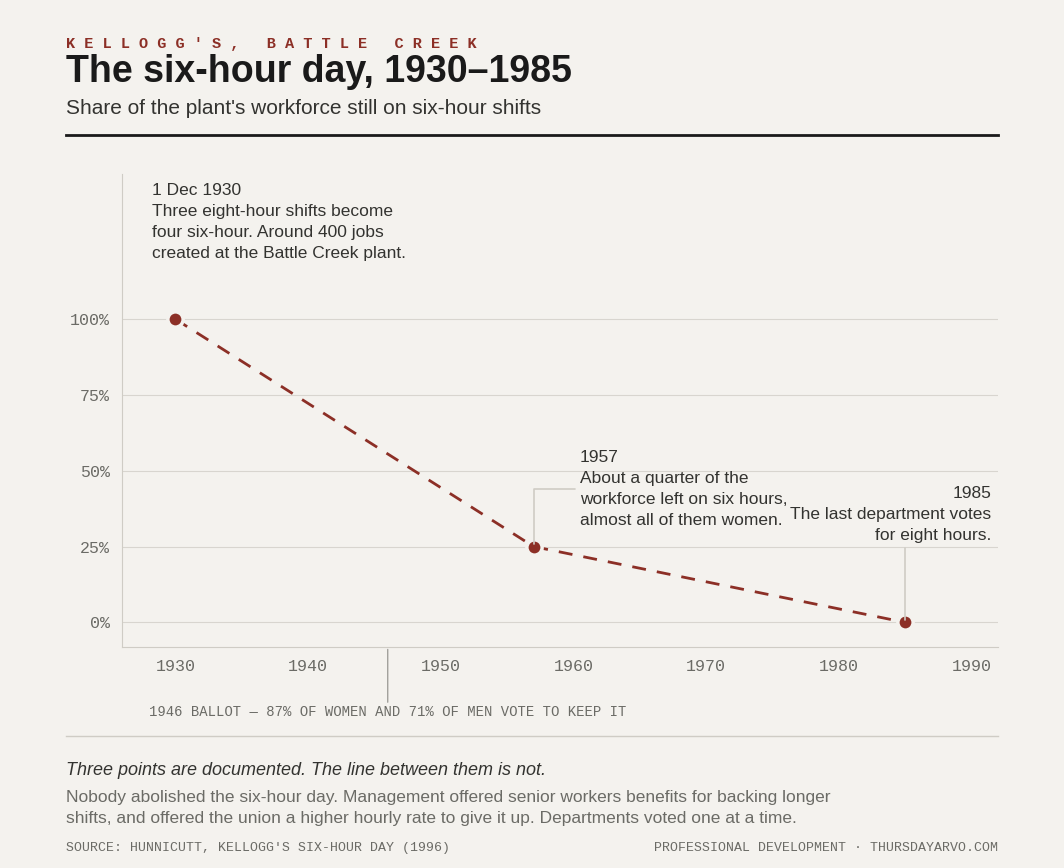 | That’s it. Go home. |
|
Professional Development · sent Thursdays, when it stops mattering
Issue 05 | SUBSCRIBE → |
|
|